

About the Project
Around 2000, research suggested feelings of isolation as being a significant factor in job dissatisfaction for arts educators, leading to a higher turnover rate among visual and performing arts teachers (Schieb, 2006). In 2005,the Arts Office of New York City Public Schools (NYCPS) rightly identified this important issue and, in response, created one of the first arts-focused and networked Professional Learning Communities (PLCs) in New York City.
Over the past 20 years, with thanks in part to several U.S. Department of Education (US DOE) grants, NYCPS has served as a laboratory for iterating and strengthening its successful arts-focused professional learning model. The national CAN project, funded in 2021 through a grant from the US DOE, has applied the NYCPS PLC model across the United States, connecting and networking solo K–12 public arts educators through virtual learning communities.
PARTNERSHIP
As the official grant recipient, NAEA hired the CAN Project Director, who was charged with ensuring CAN met its goals, enacted its vision in accordance with the prescribed timeline, reported progress to the funder, facilitated Steering Committee and Project Planning Team meetings, led content-creation retreats, and organized professional learning workshops, summer institutes, and guest speakers.
National Steering Committee
The CAN Steering Committee, consisting of senior-level executives from the national arts education associations and NYCPS, had overall programmatic, fiscal, and administrative responsibility for the project. The committee met every other week since CAN’s inception to guide the design, implementation, and evaluation and ensure the alignment of all internal and external sources in support of project objectives. Additionally, the Steering Committee took the lead in documenting best practices and lessons learned in the partnerships and focused on ensuring the art forms developed common language.
National Project Planning Team
The CAN Project Planning Team consisted of individuals selected by partner associations who developed all program content and resources. As expert facilitators and educators, the team recruited and selected Teacher Leaders, facilitated Teacher Leader PLC meetings, and coached Teacher Leaders in their own facilitation and action research projects. The Project Planning Team collaborated to design two annual “arcs of learning” for the academic year—one for national teachers, and one for NYC teachers. They develop modules in Canvas, the CAN Learning Management System, by breaking down concepts Teacher Leaders need to learn in order to turnkey the content for their PLCs. They created the CAN action research model, and a series of slideshow presentations guiding teachers through the process in an accessible way. And finally, they researched connections between the work of CAN and various existing frameworks to strengthen the relevance of the content being created.
History and Timeline
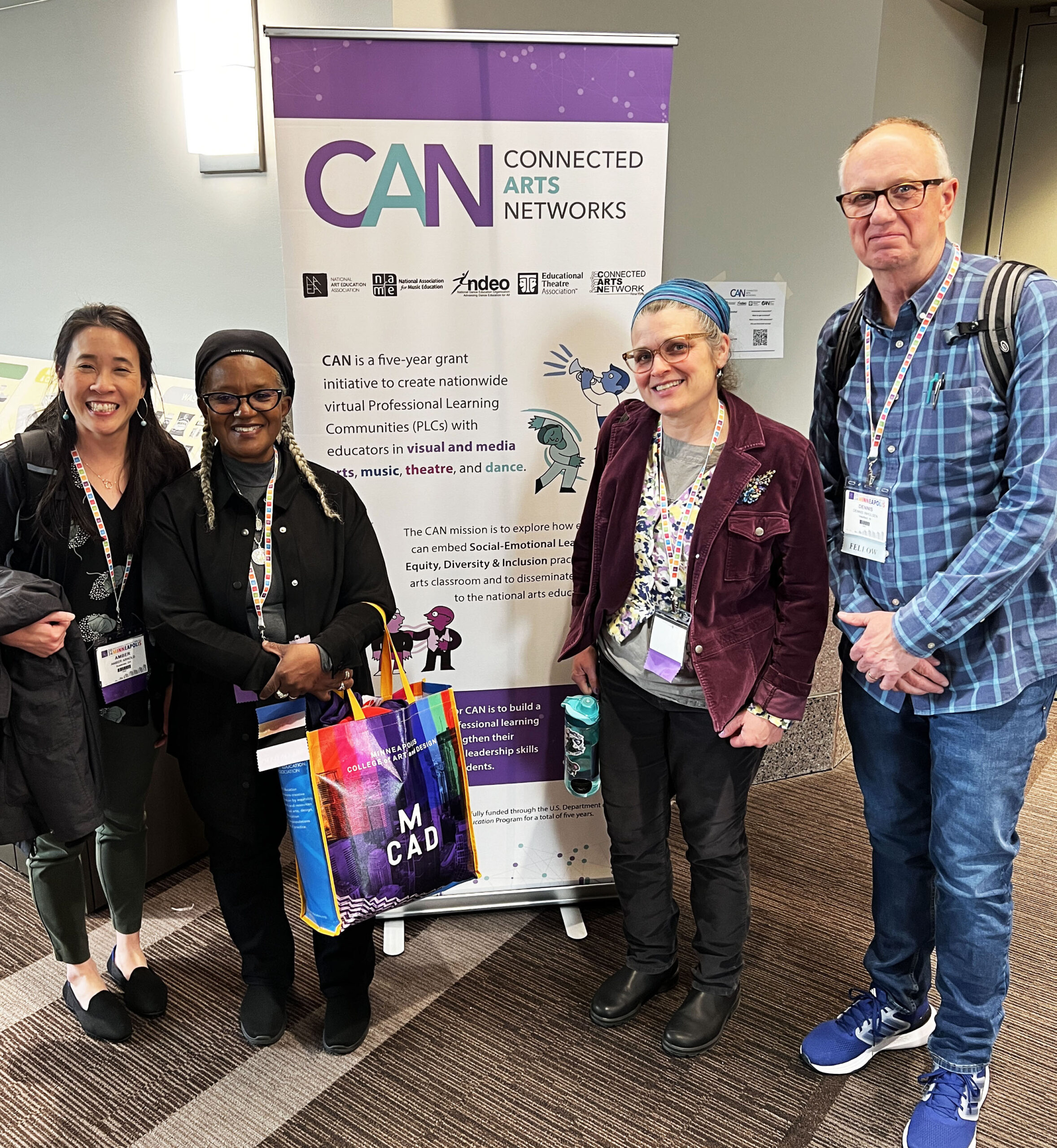
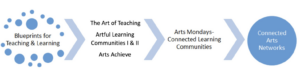
Arts-based Professional Learning Communities (PLCs) have been operating in New York City Public Schools since 2005 in different iterations that eventually became the CAN project we know today.
It was evident that the NYC PLC model was successful. The NYCPS Arts Office Executive Director brought the idea of expanding the program nationally to the NAEA Executive Director. During the COVID-19 pandemic, it became clear that virtual PLCs would be viable, allowing for a broader audience to benefit.
NYC History
- 2005: “Art of Teaching”, which was inspired by the new NYC Blueprints for Teaching and Learning in the Arts
- 2008: NYCDOE launched “Artful Learning Communities.” This initiative, funded by a US DOE PDAE grant, formally established PLCs of arts teachers within the same arts discipline and grade levels from across districts to collaborate and learn from each other.
- 2011 and 2015: This initiative was so successful that it led to two additional grants from the US DOE: Artful Learning Communities II, and “Connected Learning Communities” which expanded the model to include virtual PLCs–the precursor to CAN and its virtual PLCs
- 2015: “Arts Mondays,” an initiative launched in the Fall of 2015 and supported by the Chancellor firmly established the PLC model across the city and expanded the work of PLCs grounded in inquiry and action research and supporting teacher leadership
- 2015: the Arts Facilitator Institute was established as part of the Arts Mondays, Connected Learning Communities grant. At its height, over 100 teacher leaders facilitated more than 80 PLCs that met once a month on Monday afternoon, attended by approximately 700 arts educators across the 35 districts of NYC public schools.
- 2017: NYCArts, a virtual professional learning space, was launched to support the work of the Arts Mondays PLCs. This offered Arts Mondays members synchronous and asynchronous professional development, virtual sharing and collaboration opportunities, and recognition of advancement in the form of badging and Continuing Education Credit.
With a clear and successful model, the executive director of the NYCPS Arts Office brought the idea of expanding the program nationally to the NAEA Executive Director. Since working remotely during the COVID-19 pandemic proved virtual PLCs would be viable, this allowed for a broader audience to benefit from a program of this nature.
- December 2021: CAN Grant is awarded
- January 2022: August 2022: Planning, national call for Teacher Leaders
- September 2022–December 2023: New national Teacher Leaders have leadership training in PLCs
- January 2023–June 2024: National Teacher Leaders start their own PLCs; Teacher Participants are added in January 2024
- September 2024–June 2025: First full year of national PLCs doing action research, in line with the NYC CAN project
- September 2025–June 2026: Scheduled final year of funding and second full year of PLCs; however, funds were rescinded in September 2025.
Additional Project Details
 In Phase 1 of the grant, 60 national Teacher Leaders were chosen through an extensive application process. Selected arts educators received specialized virtual training to build their capacity to address social–emotional learning (SEL) and equity, diversity, and inclusion (ED&I) within arts instruction. Teacher Leaders had the opportunity to conduct action research within virtual PLCs focused on a “wondering” or inquiry question to deepen their practice. By equipping teachers with skills in these pressing areas, educators are supported in their professional practice and able to increase their impact on students.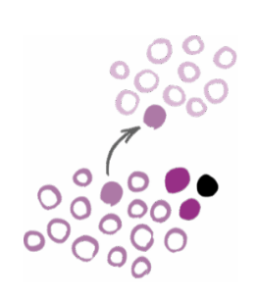
In Phase 2, Teacher Leaders took on a new role as part of the Implementation Team. Members of the four initial PLCs formed and facilitated their own virtual learning communities of arts educators and maintained these communities of support until the end of the project. This phase quadrupled the size of the national Connected Arts Networks. Simultaneously, the CAN NYC project continued their action research with approximately 85 Teacher Leaders leading PLCs locally.
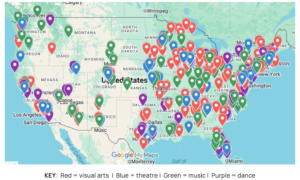
In January 2024, more than 400 inaugural Teacher Participants were welcomed into CAN PLCs with national Teacher Leaders. Arts educators in all states except North Dakota and Alaska were originally involved.
Teacher Participant Map:
The term “Professional Learning Community” (PLC) has been used to refer to any number of teacher meetings; however, at CAN, there is power in a well-facilitated PLC that combats isolation by connecting arts educators to deepen and improve their practice through action research. In Dufor et. al. (2016)’s Learning by Doing: A Handbook for Professional Learning Communities at Work, a PLC is described as “an ongoing process in which educators work collaboratively in recurring cycles of collective inquiry and action research to achieve better results for the students they serve (p. 10).”
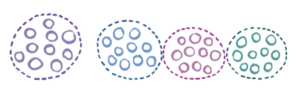
Most CAN teachers serve in communities where access to high-quality professional development is limited or nonexistent. CAN PLCs provide hundreds of arts educators with critical opportunities for collaborative planning, instructional leadership, and sustained professional growth. CAN teachers enroll in multiyear learning communities where they learn with peers and conduct individual action research projects guided by a Teacher Leader. They develop an inquiry question for the year and meet monthly in consistent groups after school hours to workshop their “wondering,” creating lessons with their peers that meet the needs of their students. CAN teachers are lifelong learners committed to their personal and professional growth, and they show their dedication by carving out time in their busy schedules to be in community with arts educators, to build each other up, and to step outside their comfort zone for their students.
The goals of CAN are universally beneficial: improve teacher practice, increase student achievement through the arts, and access to quality arts instruction. Our values serve as a throughline in all our work. We believe students benefit from curricula that reflect their culture and heritage, which means an emphasis on inspirational art by diverse artists. However, in the current political climate, this may pose challenges. The program supports the creation of arts curricula relevant to all students by encouraging teachers to connect with learners by listening to ,their stories, celebrating their strengths, and learning what they are passionate about.. Through CAN, community building is used as a method to develop a “brave space” where students feel safe and more connected to their classroom community. When this happens, students create powerful and inspiring art. .
The three original content areas of CAN— eocial–emotional learning (SEL); equity, diversity, and inclusion (ED&I), and teacher leadership— encapsulated the overall goals of the program. Over the years, the connection of SEL and ED&I practices created Culturally Responsive and Sustaining Education, which is also terminology used in NYCPS. The tangible work of CAN teachers is action research in arts-based professional learning communities. This vision for equitable and inclusive classrooms transforms action research from teaching artistic skills to, instead, teaching the whole student. For more information about the frameworks, please view the Toolbox section.
Common language to further understand this work:
- Social–emotional learning (SEL) is an integral part of education and human development. SEL is the process through which all young people and adults acquire and apply the knowledge, skills, and attitudes to develop healthy identities, manage emotions and achieve personal and collective goals, feel and show empathy for others, establish and maintain supportive relationships, and make responsible and caring decisions. SEL advances educational equity and excellence through authentic school, family, and community partnerships to establish learning environments and experiences that feature trusting and collaborative relationships, rigorous and meaningful curriculum and instruction, and ongoing evaluation. (adapted from CASEL [add link])
- Equity refers to conditions that support fairness and justice based on individual needs and circumstances, where all members have opportunities to thrive and realize their best within the community.
- Diversity describes both observable and nonobservable individual differences (life experiences, work context, learning and working styles, and personality types, among others) and/or groupsocial differences (race, gender identity and expression, age, social class, country of origin, ability, beliefs, and intellectual and cultural perspectives, among others) contributing to organizational vibrancy and a dynamic professional community.
- Inclusion describes proactive, intentional, and thoughtful engagement with diversity to the extent that all have the ability to contribute fully and effectively throughout the community and feel a sense of welcoming and belonging.
- Teacher leadership is often found in arts education classrooms because arts educators possess unique skills such asdeveloping plans to meet objectives, adapting to meet current needs, recognizing potential and coaching peers, using resources responsibly, utilizing creative processes to identify opportunities, and solving complex challenges. A leader sees how something can be improved and inspires confidence in others to move them to action. A great leader connects with people as a guide or mentor, and engages or motivates others to be visionaries. (Adapted from NAEA’s School for Arts Leaders, insert link):
As one CAN Teacher Leader aptly stated, “If changes are going to be made in the work of SEL and DEI, it begins with me, my classroom, and my interactions with people. If I am going to care for others, I must take care of myself—mentally, physically, and emotionally.”
As part of the CAN project, quarterly workshops were held each academic year on diverse topics. Each virtual workshop was led by prominent leaders in the arts; social–emotional learning (SEL); equity, diversity, and inclusion (ED&I); and teacher leadership, who guide teachers to apply theory to practice. After each workshop, Teacher Leaders created tip sheets and podcast episodes to demonstrate the uptake of these ideas in practice. These resources can be found in the Toolbox by Theme.
The CAN Summer Institute served as the official launch of national PLCs in 2022 and was held each summer with national and NYC Teacher Leaders. It was a time to meet virtually across disciplines and connect the national and local CAN projects in a shared mission. For the initial Summer Institute, “appetizer-sized portions” of the target content areas (SEL, ED&I, and teacher leadership) were provided along with time for NYC Teacher Leaders to share unit plans created within their own PLCs. In later years, educators gained inspiration from content experts, participated in breakout groups, built relationships, and planned their facilitation of PLCs during the coming academic year. Summer Institutes marked the closing of the school year and provided an opportunities to reflect on what was accomplished, while simultaneously kicking off the next school year to adapt learnings in real time to student and educator needs.

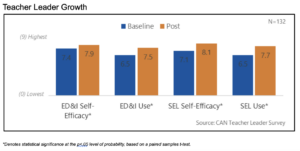
Metis Associates served as the CAN Grant Evaluator for both the national PLCs and NYC PLCs. The NYC Connected Arts Network (singular) has been meeting in PLCs for 10 years, growing to 83 Teacher Leaders directing their own PLCs. Recently (the 2021–2022 program year), NYC PLCs began focusing on SEL and ED&I, like the national PLCs. National Teacher Leaders followed the same evaluation processes as NYC PLCs using tools developed by Metis:
- Teacher Leader Self-Assessment Survey: Designed to determine changes in facilitators’ perceived self-efficacy for implementing culturally responsive instruction and SEL practicesto implement ED&I and SEL principles in arts-based instruction distributed on a pre/post basis.
- Panorama Student Survey: A validated assessment, on a pre/post basis, to sample students of participating arts educators to measure the development of students’ self-esteem, self-awareness, emotional resilience, social awareness, and conflict-resolution skills.
The Connected Arts Networks are both a bold experiment and a powerful proof of concept in demonstrating how educators grow in skill,leadership, advocacy, and community when arts disciplines work together. Through this collaboration, work conducted across five national arts education organizations helped build powerful connections while elevating the collective voice of arts educators. The teachers who participated amplified the power of their voices as advocates for students, for their art form, and for the role of the arts in education. Together, the involved organizations created and championed an arts mindset that values creativity, collaboration, and humanity in every classroom.
The contents of these resources were developed under a grant from the U.S. Department of Education’s Assistance for Arts Education Program. However, the contents do not necessarily represent the policy of the Department of Education, and you should not assume endorsement by the Federal Government.